Aiden Woojin Chang
Finding the Sound Within
How curiosity, quiet confidence, and deep listening are shaping piano student, Aiden Woojin Chang’s musical journey at Berklee.
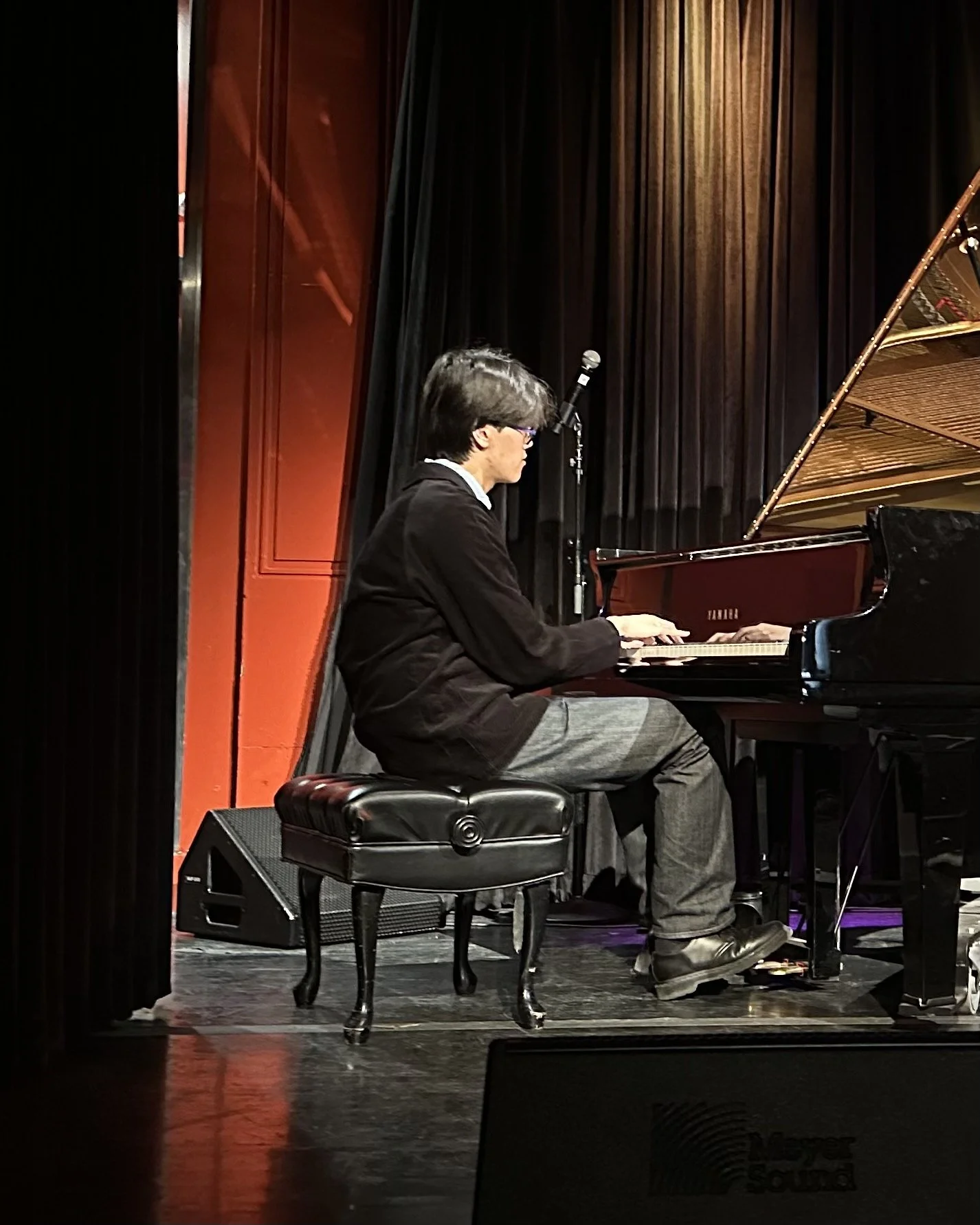
When pianist Aiden Woojin Chang talks about his goals as a music performer, he does not reach first for big declarations or polished language, he reaches for feeling.
Soft. Comforting. Cozy.
Those are the words he uses to describe his sound. In many ways, they reveal something deeper about the way he moves through music itself. Aiden’s playing is thoughtful, responsive, and deeply attuned to the people around him. There is a calm clarity in the way he listens, a quiet confidence in the way he supports others, and a sense that for him, music is not about forcing a moment, but finding it. That sensibility has made Chang a striking presence in Berklee’s ensemble community, where he is steadily growing not only as a pianist, but as a collaborator, composer, and artist.
A Musical Beginning Rooted in Family
Chang’s journey into music began in a way that feels both contemporary and deeply personal. At eleven years old, he was running a gaming YouTube channel and needed background music for his videos. Instead of searching for tracks elsewhere, his father, a jazz pianist and composer, offered a simple suggestion, “Why not make the music himself?”.
That moment changed everything.
Together, father and son began creating music in Logic Pro. What started as a practical solution quickly became a creative awakening. “That was how I started,” Chang says.
The story says a lot about who he is as an artist today. His entry point into music was not about performance alone. It was about curiosity, experimentation and creating something of his own.
“I started making music with my father, and that was how it all began.”
Drawn to Berklee by Possibility
Originally from South Korea, Aiden chose Berklee because of its openness. The appeal was not just the school’s reputation, but its range.
“The biggest reason was the diversity of Berklee,” he says. He was drawn to the fact that Berklee is not confined to one tradition or one lane. It is a place where many styles can exist side by side, where students can explore different sounds and perspectives, and musical identity can expand. That sense of possibility continues to shape the way Aiden approaches ensemble life.
Learning Through the Ensemble Experience
Though Aiden is only in his second semester at Berklee, he has already immersed himself deeply in the ensemble experience, participating in three ensembles last semester and currently playing in five. For a student who says he had limited ensemble experience before coming to Berklee, that growth has been significant.
“This is where I really started to learn how to communicate with the band,” he says. That word, communicate, comes up again and again in the way Chang talks about music. For him, ensemble playing is not simply about accuracy or individual skill. It is about connection, learning how to respond and listening closely enough that the music can breathe between people.
Through that process, Aiden has discovered something important: “Music is not only about individual skill,” he says. “It is also about ourselves, who we are.”
“Music is not only about individual skill. It is also about who we are.”
The Art of Listening
One of the most revealing moments in the conversation came when Chang described how he connects with other musicians in an ensemble. He does not try to manufacture interaction or force the moment. Instead, Aiden listens and responds honestly to what he hears.
“If I try to force communication, I think that will not sound good,” he says. So what does he do instead? “I just listen to them, and then play what I hear in my inner mind,” says Chang.
It is a beautiful articulation of musical trust. Aiden supports others while staying true to his own voice. He does not disappear inside the ensemble, but he also does not dominate it. He listens, interprets, and contributes from a place that feels natural and grounded. That balance is part of what makes his playing feel so connected.
A Memorable Ensemble Moment
When asked about an ensemble experience that pushed him outside his comfort zone, Aiden immediately recalled a moment from Professor Crystal Torres’ class when the lights were turned off, and students had to rely entirely on their ears. “I could not see anything,” he remembers. “So I really had to rely on my ears and try to connect with the sound.”
For him, it was a special experience and one that stayed with him. The moment speaks to something essential about the ensemble process at its best. It asks students to go beyond habit, beyond visual cues, beyond control. Ensemble playing asks musicians to trust their listening and truly connect with one another. For Aiden, that challenge seems to have opened something meaningful.
Preparing for a Major Performance
This semester, Chang reached an important milestone in his young Berklee career.
After winning the Billy Strayhorn competition last semester, he earned the opportunity to present a concert at the 939 Red Room. The competition asked Berklee piano students to perform one Billy Strayhorn piece and one original composition. Out of roughly twenty students, Aiden Woojin Chang emerged as the winner. For an artist who describes Billy Strayhorn as one of his favorite composers, the experience carried special weight. “It was absolutely a really great honor,” he says.
He also had the opportunity to interview Billy Strayhorn’s nephew through the Billy Strayhorn Foundation, making the experience even more meaningful.
For the concert, Chang prepared both Strayhorn works and original music, bringing his own personality and creative voice to the material. In the process, he also challenged himself to write new pieces rather than rely on older work. One of those compositions took three to four weeks to complete, largely because he loved the opening section but struggled to find the right ending. In the end, he finished it, and that persistence says just as much about the artist as the music itself.
Growth Through Reflection
Aiden also points to reflection as an important part of his development. He spoke warmly about being asked questions after run throughs in ensemble rehearsals, and about how that process helps students think more deeply about what happened in the music and how the musicians are growing through performing it. For him, that kind of guided reflection has helped strengthen not only his awareness, but his communication. It has also helped him understand that being a strong musician begins somewhere even more fundamental.
“I thought that I should first become a good person before I become a good pianist or good musician.”
It is a striking statement, especially from a young artist still early in his Berklee experience, but it also reflects a maturity that feels fully aligned with the spirit of ensemble work.
Because in any ensemble, musicianship is never just about what you play, it is also about how you show up.
What Community Means
When Chang speaks about the community at Berklee, he describes it simply and beautifully. “A place where anybody can feel comfortable and can be really connected with each other.”
Aiden says he finds that feeling in jam sessions, ensemble classes, and rehearsals. In other words, community is not an abstract idea for him. It is something built in real time through shared music making, mutual respect, and inspiration. That sense of belonging seems to matter deeply to him and so does friendship. When asked to imagine his dream ensemble or concert experience at Berklee, Aiden did not describe a famous venue or flashy concept, he described people. He wants a real connection. Aiden want to perform with good friends, good people and musicians who have strong personalities whose playing reflects who they are.
“I want to perform original music,” he says, “music that has each other’s personality.”
That answer says everything. For Chang, the dream is not just excellence, it is honesty, trust, and shared expression.
Music That Stays With People
When asked how he hopes his music will affect others, Aiden expressed how he hopes people will feel inspired by his music and more than anything, he hopes the music stays with them.
He described how certain songs can bring back the feeling of a place, a memory, or a moment from years before. That is what he wants his music to do.
“I hope that my music stays in their heart,” he says. It is a quiet answer, but a powerful one. An answer that feels deeply consistent with the sound he described at the very beginning:
Soft. Comforting. Cozy. Music that stays.
An Artist to Watch
There is something deeply compelling about the way Aiden Woojin Chang approaches music.
He is reflective without being distant, sensitive without losing clarity, humble but unmistakably serious about the craft. He listens closely, plays honestly, and seems less interested in performance as a display. Instead, Aiden uses performance as a medium for connection. In an ensemble culture that values collaboration, listening, and shared growth, this makes him not only a strong pianist, but a meaningful part of the community. As Aiden Woojin Chang continues to grow at Berklee, it feels likely that this is only the beginning.
At a Glance: Aiden Woojin Chang
Student: Aiden Woojin Chang
Principal Instrument: Piano
From: Seoul, South Korea
Sound in Three Words: Soft, comforting, cozy.
Why Berklee?: “Its musical diversity and openness across styles.”
Recent Milestone: Winner of the Billy Strayhorn competition, earning a featured concert at the 939 Red Room.
What ensembles have taught Aiden: How to communicate, listen deeply, and grow as both a musician and a person.
Dream performance: Playing original music with good friends and good people whose personalities come through in the sound
What he hopes listeners feel: Something memorable (nostalgia) that stays in their heart
Footage courtesy of: The Red Room
Berklee piano student and winner of the Billy Strayhorn competition pays homage to the composer with he and Lois Major’s duo version of, “Isfahan”.
